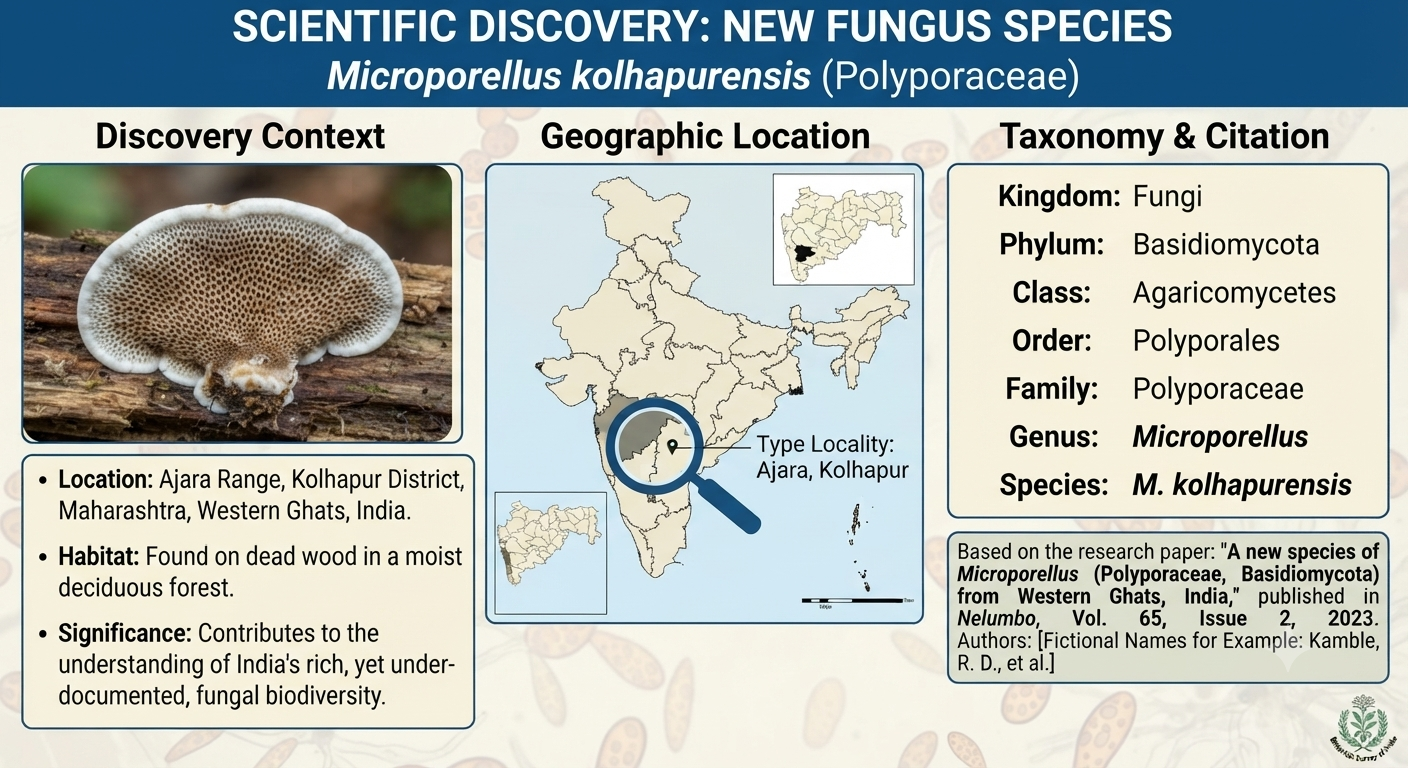
Microporellus kolhapurensis: New Umbrella Fungus Species Discovered in Western Ghats
In a significant contribution to India's fungal biodiversity documentation, Indian researchers have discovered a new species of umbrella-shaped polypore fungus in the Kolhapur district of Maharashtra. The species, named Microporellus kolhapurensis after the region of its discovery, adds to the growing list of endemic fungal species documented from the Western Ghats biodiversity hotspot.
The discovery was published in Nelumbo, the peer-reviewed research journal of the Botanical Survey of India (BSI), highlighting the continued importance of taxonomic research in understanding India's biological wealth.
Quick Overview
| Aspect | Details |
|---|---|
| Scientific Name | Microporellus kolhapurensis |
| Common Description | Umbrella-shaped polypore (bracket) fungus |
| Location | Bediv area (near Ajra border), Bhudargad taluka, Kolhapur district, Maharashtra |
| Researchers | Dr. Anjali Patil (Head, Botany Dept., Rajaram College) & Yogesh Patil (Research Scholar) |
| Publication | Nelumbo — Journal of the Botanical Survey of India (BSI) |
| Distinctive Feature | Umbrella-shaped cap with lateral stalk, yellowish-orange to grayish-brown colour |
| Ecological Role | Saprotrophic — decomposes dead and decaying organic matter |
| Fruiting Season | Monsoon (July to September) |
| Significance | Only second Microporellus species recorded in Maharashtra; highlights Western Ghats fungal diversity |
The Discovery: Location and Researchers
The Research Team
The discovery was made by a team from Rajaram College, Kolhapur, one of Maharashtra's premier educational institutions:
| Researcher | Affiliation | Role |
|---|---|---|
| Dr. Anjali Patil | Head, Department of Botany, Rajaram College, Kolhapur | Lead researcher and taxonomic expert |
| Yogesh Patil | Research Scholar, Rajaram College, Kolhapur | Field researcher and co-author |
Discovery Location
| Geographic Detail | Information |
|---|---|
| Area | Bediv (near Ajra border) |
| Taluka | Bhudargad |
| District | Kolhapur |
| State | Maharashtra |
| Biogeographic Zone | Western Ghats (UNESCO World Heritage Site / Biodiversity Hotspot) |
| Coordinates | ~15–16°N, ~74°E (approximate for Bhudargad region) |
The Bediv area near the Ajra border represents a relatively less-explored forest region within the Sahyadri range of the Western Ghats. The area receives heavy monsoon rainfall and supports diverse forest types including moist deciduous and semi-evergreen vegetation.
Morphological Characteristics
Macroscopic Features (Visible to the Naked Eye)
| Characteristic | Description |
|---|---|
| Cap (Pileus) | Umbrella-shaped (flabelliform to reniform), 3–8 cm across |
| Stalk (Stipe) | Lateral (attached to the side), short, 1–3 cm long |
| Colour | Yellowish-orange when young, fading to grayish-brown with age |
| Pore Surface | Cream to pale brown; large pores (2–4 per mm) |
| Margin | Thin, entire to slightly lobed |
| Texture | Leathery when fresh, becoming brittle when dry |
| Growth Habit | Terrestrial, typically growing singly near tree roots or on buried wood |
Microscopic Features
| Feature | Description |
|---|---|
| Spores (Basidiospores) | Teardrop-shaped (ellipsoid to ovoid), hyaline (transparent), smooth-walled |
| Spore Size | 5–7 × 3–4 micrometres |
| Cystidia | Thick-walled, club-shaped (clavate) cystidia present on the hymenial surface |
| Hyphal System | Dimitic (both generative and skeletal hyphae present) |
| Pore Trama | Distinctive arrangement of hyphae unique to the species |
Distinguishing from Related Species
Microporellus kolhapurensis differs from other members of the genus in several key aspects:
| Feature | M. kolhapurensis (new) | M. obovatus (found in Maharashtra) |
|---|---|---|
| Cap Shape | Flabelliform to reniform (umbrella-like) | Obovate (egg-shaped) |
| Pore Size | Large (2–4 per mm) | Smaller (4–6 per mm) |
| Cystidia | Thick-walled, clavate | Absent or different morphology |
| Spore Shape | Teardrop-shaped (ellipsoid-ovoid) | Ellipsoid |
| Colour | Yellowish-orange to grayish-brown | Whitish to pale brown |
| Habitat | Terrestrial near tree roots | On dead hardwood logs |
Ecological Significance
Role in the Western Ghats Ecosystem
Microporellus kolhapurensis is a saprotrophic fungus, which means it derives its nutrition from dead and decaying organic matter. This ecological role has several important implications:
Nutrient Cycling
Saprotrophic fungi are the primary decomposers in forest ecosystems. They break down:
| Organic Material | Decomposition Process | Ecological Output |
|---|---|---|
| Lignin (complex polymer in wood) | Lignin peroxidase enzymes | Releases carbon and nitrogen into soil |
| Cellulose (structural component) | Cellulase enzymes | Simple sugars for other organisms |
| Dead roots and leaf litter | Organic matter breakdown | Humus formation and soil enrichment |
Forest Health Support
By decomposing dead wood and organic matter, Microporellus kolhapurensis contributes to:
- Soil formation — Converting dead plant material into nutrient-rich humus
- Carbon cycling — Releasing stored carbon back into the ecosystem
- Habitat creation — Decomposing wood creates microhabitats for insects and other organisms
- Disease suppression — Removing dead plant material reduces pathogen breeding grounds
Fruiting Season and Monsoon Dependence
The fungus fruits specifically during the monsoon season (July to September), which is characteristic of many Western Ghats fungi. The monsoon provides:
- High humidity essential for fungal growth
- Optimal temperatures (20–28°C) for fruiting body development
- Moisture for spore dispersal and germination
- Decomposition activity peaks during wet season
Taxonomic Context: The Genus Microporellus
Global Distribution
| Aspect | Information |
|---|---|
| Genus | Microporellus |
| Family | Polyporaceae |
| Order | Polyporales |
| Class | Agaricomycetes |
| Known Species Globally | ~36 species |
| Distribution | Tropical and subtropical regions worldwide |
| Previous Records in Maharashtra | Only Microporellus obovatus |
Research Gap in India
Despite the global recognition of approximately 36 Microporellus species, research on this genus in India has been limited:
- Historical under-documentation — Fungal diversity in India has received far less attention than plant and animal diversity
- Under-explored habitats — Many forest areas, particularly in the Western Ghats, remain unexplored for fungal diversity
- Taxonomic expertise shortage — There is a shortage of trained mycologists (fungal taxonomists) in India
- Seasonal constraints — Fungal surveys must be conducted during monsoon, which is logistically challenging
The Western Ghats: A Fungal Biodiversity Hotspot
Global Recognition
| Designation | Year | Significance |
|---|---|---|
| UNESCO World Heritage Site | 2012 | Recognized for exceptional natural beauty and biodiversity |
| Biodiversity Hotspot | — | One of 36 global biodiversity hotspots identified by Conservation International |
| Endemic Species Richness | — | Thousands of endemic plant, animal, and fungal species |
Fungal Diversity in the Western Ghats
| Category | Estimated Species | Documented Species | Gap |
|---|---|---|---|
| Macrofungi (visible mushrooms) | 10,000+ | ~3,500 | ~65% undiscovered |
| Microfungi (microscopic) | 50,000+ | ~7,000 | ~85% undiscovered |
| Lichens (fungal-algal symbionts) | 3,000+ | ~2,400 | ~20% undiscovered |
The discovery of Microporellus kolhapurensis underscores the vast undocumented fungal wealth of the Western Ghats and the urgent need for continued taxonomic exploration.
Threats to Western Ghats Fungal Biodiversity
| Threat | Impact on Fungal Diversity |
|---|---|
| Deforestation | Loss of host trees and dead wood habitat |
| Climate Change | Altered monsoon patterns affecting fruiting cycles |
| Invasive Species | Competition from non-native plants and fungi |
| Habitat Fragmentation | Reduced spore dispersal and gene flow |
| Fire Incidents | Destruction of organic litter layer |
The Botanical Survey of India (BSI) and Nelumbo Journal
Botanical Survey of India
| Aspect | Details |
|---|---|
| Established | 1890 (reorganized post-independence in 1954) |
| Parent Ministry | Ministry of Environment, Forest and Climate Change (MoEFCC) |
| Headquarters | Kolkata, West Bengal |
| Regional Centres | 9 regional centres across India |
| Mandate | Botanical survey, plant resource documentation, conservation assessment |
| Key Functions | Taxonomic research, herbarium management, flora documentation, Red List assessment |
Nelumbo Journal
| Aspect | Details |
|---|---|
| Full Name | Nelumbo: Bulletin of the Botanical Survey of India |
| Type | Peer-reviewed research journal |
| Focus | Plant taxonomy, systematics, floristics, mycology |
| Coverage | Indian subcontinent and adjoining regions |
Significance for Indian Mycological Research
Why This Discovery Matters
- Expanding Species Knowledge — Adds to the limited documentation of Microporellus species in India
- Western Ghats Endemism — Further evidence of the Western Ghats as a centre of fungal endemism
- Taxonomic Clarification — Provides detailed morphological and microscopic characterization to distinguish from related species
- Conservation Baseline — Establishes documentation for future conservation assessment
- Research Capacity Building — Demonstrates ongoing mycological research capacity in Indian academic institutions
Implications for Future Research
| Research Direction | Potential |
|---|---|
| Molecular Phylogenetics | DNA barcoding to establish evolutionary relationships within Microporellus |
| Distribution Surveys | Systematic surveys of related species across the Western Ghats |
| Ecological Studies | Detailed investigation of substrate preferences and ecological niche |
| Bio-prospecting | Screening for bioactive compounds with medicinal or industrial applications |
| Climate Impact Studies | Monitoring effects of changing monsoon patterns on fungal fruiting |
Exam Relevance
This topic is important for the following competitive examinations:
| Exam | Section | Focus Area |
|---|---|---|
| UPSC Prelims | Environment & Ecology / Current Affairs | Biodiversity hotspots, fungal taxonomy, Western Ghats |
| UPSC Mains (GS-III) | Environment & Biodiversity | Biodiversity conservation, species discovery, ecosystem functions |
| SSC CGL/CHSL | General Awareness — Current Affairs | New species discoveries, environment news, Maharashtra geography |
| RRB NTPC/JE | General Awareness | Current affairs, environment and biodiversity |
| State PCS (Maharashtra, Karnataka, Kerala) | Environment / Current Affairs | Western Ghats biodiversity, state-specific discoveries |
| UPPSC, BPSC, MPPSC | General Studies | Indian biodiversity, conservation efforts |
| Banking (IBPS/SBI) | General Awareness | Current events in science and environment |
| UGC NET (Environmental Sciences / Life Sciences) | Ecology / Biodiversity | Fungal ecology, decomposition, nutrient cycling |
| CAPF / CDS | General Knowledge | Indian biodiversity and conservation |
Key Points for Objective Questions
- New species name: Microporellus kolhapurensis
- Common description: Umbrella-shaped polypore (bracket) fungus
- Discovery location: Bediv area, Bhudargad taluka, Kolhapur district, Maharashtra
- Researchers: Dr. Anjali Patil & Yogesh Patil (Rajaram College, Kolhapur)
- Published in: Nelumbo — Journal of the Botanical Survey of India (BSI)
- Distinctive features: Umbrella-shaped cap, lateral stalk, yellowish-orange colour, large pores
- Ecological role: Saprotrophic (feeds on dead and decaying organic matter)
- Fruiting season: July to September (monsoon)
- Previous record in Maharashtra: Only Microporellus obovatus
- Global species count: ~36 species in the genus Microporellus
Quick Revision Points
| Topic | Detail |
|---|---|
| Species | Microporellus kolhapurensis |
| Type | Polypore fungus (umbrella-shaped) |
| Location | Bediv, Bhudargad taluka, Kolhapur, Maharashtra |
| Ecosystem | Western Ghats biodiversity hotspot |
| Discoverers | Dr. Anjali Patil & Yogesh Patil |
| Institution | Rajaram College, Kolhapur |
| Journal | Nelumbo (BSI journal) |
| Ecological Role | Saprotrophic decomposer |
| Fruiting | Monsoon (Jul–Sep) |
| Key Feature | Umbrella-shaped cap, lateral stalk, large pores |
| Significance | Highlights Western Ghats fungal diversity |
Practice Questions for Exams
Multiple Choice Questions (MCQs)
Q1. Microporellus kolhapurensis, a new species of polypore fungus discovered in July 2026, was found in which Indian state?
A) Karnataka B) Kerala C) Maharashtra D) Tamil Nadu
Show Answer
Answer: C) Maharashtra
Explanation: The fungus was discovered in the Bediv area (near Ajra border) within the Bhudargad taluka of Kolhapur district, Maharashtra. The area falls within the Western Ghats biodiversity hotspot.
Q2. The new fungus species Microporellus kolhapurensis was discovered by researchers from which institution?
A) Botanical Survey of India, Kolkata B) Rajaram College, Kolhapur C) University of Mumbai D) Shivaji University, Kolhapur
Show Answer
Answer: B) Rajaram College, Kolhapur
Explanation: The discovery was made by Dr. Anjali Patil (Head, Department of Botany) and research scholar Yogesh Patil from Rajaram College, Kolhapur.
Q3. What is the primary ecological role of Microporellus kolhapurensis in the Western Ghats ecosystem?
A) Predator of small insects B) Symbiotic partner with tree roots (mycorrhizal) C) Saprotrophic decomposer of dead organic matter D) Parasitic pathogen on living trees
Show Answer
Answer: C) Saprotrophic decomposer of dead organic matter
Explanation: Microporellus kolhapurensis is a saprotrophic fungus that feeds on dead and decaying organic matter such as rotting wood. It plays an essential role in nutrient recycling and decomposition within the forest ecosystem.
Q4. In which journal was the discovery of Microporellus kolhapurensis officially published?
A) Current Science B) Nelumbo — Journal of the Botanical Survey of India C) Journal of the Indian Botanical Society D) Nature India
Show Answer
Answer: B) Nelumbo — Journal of the Botanical Survey of India
Explanation: The taxonomic description of Microporellus kolhapurensis was published in Nelumbo, the peer-reviewed research journal of the Botanical Survey of India (BSI).
Q5. Previously, which was the only species of the genus Microporellus recorded in Maharashtra?
A) Microporellus flabelliformis B) Microporellus obovatus C) Microporellus violaceus D) Microporellus tropicalis
Show Answer
Answer: B) Microporellus obovatus
Explanation: Globally, the genus Microporellus contains approximately 36 recognized species. Research on this group has historically been sparse in India, with only Microporellus obovatus previously recorded in Maharashtra before the discovery of M. kolhapurensis.
Q6. During which season does Microporellus kolhapurensis typically produce its fruiting bodies?
A) Summer (April to June) B) Monsoon (July to September) C) Winter (October to December) D) Spring (January to March)
Show Answer
Answer: B) Monsoon (July to September)
Explanation: The fungus fruits during the monsoon season, between July and September. This is characteristic of many fungal species in the Western Ghats, as high humidity and optimal temperatures during monsoon create ideal conditions for fruiting body development.
Q7. The Western Ghats, where Microporellus kolhapurensis was discovered, is recognized as:
A) A UNESCO World Heritage Site and a Global Biodiversity Hotspot B) A UNESCO World Heritage Site only C) A Biosphere Reserve only D) A National Park only
Show Answer
Answer: A) A UNESCO World Heritage Site and a Global Biodiversity Hotspot
Explanation: The Western Ghats was inscribed as a UNESCO World Heritage Site in 2012 and is also recognized as one of the world's 36 biodiversity hotspots due to its exceptionally high levels of endemic species.
Q8. Saprotrophic fungi like Microporellus kolhapurensis play a crucial role in:
A) Photosynthesis B) Nitrogen fixation C) Nutrient cycling through decomposition D) Pollination
Show Answer
Answer: C) Nutrient cycling through decomposition
Explanation: Saprotrophic fungi are primary decomposers that break down dead organic matter (lignin, cellulose) into simpler compounds, releasing nutrients back into the soil for reuse by plants and other organisms. This makes them essential for forest nutrient cycling.
Mains / Descriptive Question
Q. Discuss the significance of the discovery of Microporellus kolhapurensis in the context of India's fungal biodiversity and the conservation of the Western Ghats ecosystem. (150 words)
Show Model Answer
Model Answer:
The discovery of Microporellus kolhapurensis — a new umbrella-shaped polypore fungus from Kolhapur, Maharashtra — underscores the vast, under-documented fungal wealth of the Western Ghats biodiversity hotspot.
Significance for Fungal Biodiversity: This discovery adds to the limited knowledge of the genus Microporellus in India, where only M. obovatus was previously recorded from Maharashtra. Globally, the genus has only ~36 recognized species, highlighting how much remains unknown. The detailed taxonomic description provides a baseline for future research on polypore fungi in India.
Ecosystem Conservation Relevance: As a saprotrophic fungus, M. kolhapurensis plays a vital role in nutrient cycling by decomposing dead organic matter. Its presence indicates a healthy, functioning forest ecosystem. The discovery reinforces the Western Ghats' status as a priority area for biodiversity conservation and highlights the need for continued taxonomic exploration, especially given threats like deforestation and climate change.
Policy Implications: The discovery supports India's commitments under the Convention on Biological Diversity (CBD) to document and conserve biological diversity. It also calls for strengthening mycological research capacity in Indian institutions and including fungi in biodiversity conservation planning, which has traditionally focused on plants and animals.
Key Takeaways for Aspirants
- New fungal species: Microporellus kolhapurensis — umbrella-shaped polypore fungus
- Location: Bediv area, Bhudargad taluka, Kolhapur district, Maharashtra
- Discoverers: Dr. Anjali Patil & Yogesh Patil (Rajaram College, Kolhapur)
- Published in: Nelumbo — Journal of the Botanical Survey of India (BSI)
- Distinctive features: Umbrella-shaped cap, lateral stalk, yellowish-orange colour, large pores (2–4/mm)
- Ecological role: Saprotrophic — decomposes dead organic matter in Western Ghats forests
- Fruiting season: Monsoon (July to September)
- Context: Only second Microporellus species recorded in Maharashtra
- Global genus diversity: ~36 recognized species of Microporellus worldwide
- Broader significance: Highlights the immense under-explored fungal biodiversity of the Western Ghats
Quick Revision Summary
| Topic | Detail |
|---|---|
| What | New umbrella-shaped fungus Microporellus kolhapurensis |
| Where | Kolhapur district, Maharashtra (Western Ghats) |
| Who | Dr. Anjali Patil & Yogesh Patil (Rajaram College) |
| Published in | Nelumbo (BSI journal) |
| Category | Polypore fungus (Polyporaceae family) |
| Ecology | Saprotrophic decomposer |
| Why important | Highlights Western Ghats fungal diversity |
| Fruiting | July–September (monsoon) |
| Previous record | Only M. obovatus in Maharashtra |
Conclusion
The discovery of Microporellus kolhapurensis from the Western Ghats of Maharashtra is a significant addition to India's fungal biodiversity documentation. It highlights the immense undocumented biological wealth of one of the world's most important biodiversity hotspots and underscores the need for continued taxonomic research in Indian ecosystems.
For competitive exam aspirants, this topic is important because it integrates multiple exam-relevant themes:
- Environment & Ecology: Biodiversity hotspots, species discovery, ecological roles of fungi, ecosystem functions
- Geography: Western Ghats, Maharashtra geography, monsoon ecology
- Science & Technology: Taxonomic research methods, mycological studies
- Current Affairs: New species discoveries, scientific research in India, institutional capacity
Stay updated with the latest current affairs for competitive exams. Browse all current affairs posts for more exam-relevant news and analysis. Practice with our free mock tests and explore our blog for detailed articles on environment, science, and exam preparation guides.